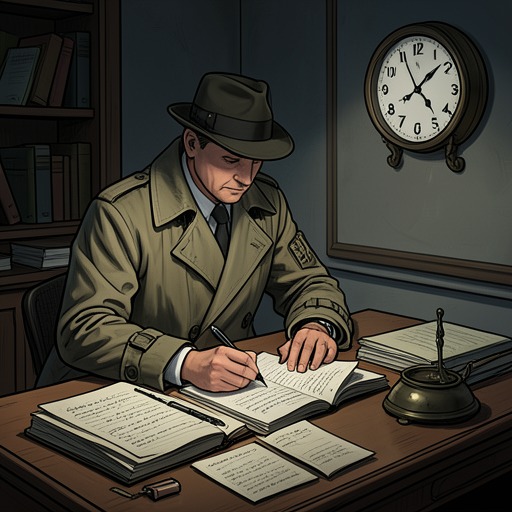
The “half clue” and the uncertainty of evidence
I'll Be Gone in the DarkThe “half clue” and the uncertainty of evidence names a condition that runs through the book’s investigations: a detail can be real, striking, and potentially meaningful without being strong enough to establish what happened or who was responsible. Paul Holes describes the predicament plainly: evidence may point toward a possibility, yet stop short of a traceable conclusion. The distinction matters. Suspicion can accumulate; certainty does not necessarily follow.
What Makes a Clue Incomplete
A clue may be an observed fact, an imperfect recollection, or an inference attached to either one. Those categories can blur when investigators revisit a case: a remembered image may acquire new significance, while the proposed explanation for a physical trace remains only a possibility. The book repeatedly preserves that separation rather than treating every suggestive detail as a solution.
The East Area Rapist’s apparent knowledge of people and neighborhoods offers one example of evidence that supports a pattern without resolving its source. Reports described prowling and unlawful entries in homes near a future victim’s, small items going missing, and hang-up calls increasing in the surrounding four- or five-block radius before an attack. Taken together, these incidents suggest neighborhood reconnaissance. But the reports do not, by themselves, establish exactly how he learned residents’ routines or which details informed his choices. A pattern can make an offender’s method legible while leaving the individual steps hidden.
The limits of observation also shaped what neighbors did. As public awareness grew, some residents described recognizing the danger from accounts they had heard, while others retreated indoors rather than intervene or call police. The book contrasts this later, defensive response with the earlier absence of awareness. A scream, a person jumping a fence, or a late-night noise could be mistaken for something ordinary. Such accounts illuminate the conditions in which an offender could remain unseen, but they do not turn every unreported sound into evidence of a specific crime.
Traces and Competing Interpretations
A remembered van illustrates how an ordinary fragment can become consequential without becoming conclusive. Under hypnosis, a husband recalled returning home with his wife at about 11:15 p.m. on the evening of an attack and seeing a young man beside a parked van on the neighboring side street. The van was box-shaped, white over aqua green; the man appeared to be in his twenties and was stooped near its right rear corner, as though checking a tire. The recollection supplied concrete particulars, but the narrator emphasizes the uncertain weight of a snapshot recalled only after it had become important. Its detail did not establish the man’s identity or his purpose.
In another account, a stolen Ford Galaxie 500 was found with blood inside after an escape through a Christmas tree farm. A trail of blood crossed east over a curb; crumpled tissues lay in the gutter, and the drops grew smaller before disappearing. Holes speculated that the fleeing person might have struck a tree before reaching the car, but the possible collision was not established, and the physical evidence was long gone. The trail offered a sequence to consider, not a route to a suspect’s front door. Holes’s description of such material as a half clue captures the tension between having something to follow and having enough to prove.
The reports also show how investigative interpretation can circle without advancing. Holes concedes that the offender’s statements to victims included deflection and misdirection: claims about living in a van or by a river did not fit neatly with other observations, and invented connections to victims could not be taken as reliable biography. The book presents competing explanations for his behavior without settling them. In discussing his breathing, for instance, it records both the possibility of a tactic meant to frighten victims and the possibility of genuine respiratory distress. The evidence permits speculation, but the speculation reaches a dead end rather than a hidden answer.
Memory, Time, and the Families Left Waiting
For Roger Harrington, the incomplete record became an enduring personal burden. He repeatedly examined the details surrounding the murders of Keith Harrington and Patty Harrington, hired a private investigator, offered a large reward, and arranged for friends and co-workers to be interviewed again. None of these efforts produced the needed lead. In desperation, he consulted a clairvoyant, who could not clarify the case either. The details remained separate fragments, returning without forming a coherent account.
The passage of time did not make the uncertainty harmless. A magazine profile of Roger’s search ended with his stated determination to learn what had happened before he died. Yet three glass tubes, kept in manila envelopes and unmoved for fifteen years, ultimately advanced the investigation. Orange County Sheriff’s Department investigators opened and tested them in October and November 1996 and had results by December. Roger had died on March 8, 1995, so he never received the news. The sequence gives the material evidence a particular force: a long-awaited break arrived, but too late for the family member who had spent years pursuing it.
The later information also corrected Roger’s interpretation of one detail. He had believed the killer covered Keith and Patty’s heads with a bedspread out of remorse. The book explains that this was not the reason: after a previous couple’s murder had been messy, the killer did not want blood on himself. The correction demonstrates both the importance and the limits of inference. Roger had noticed a real detail, but without the killer’s history its meaning remained inaccessible to him.
The Unfinished Record
The concept extends beyond physical evidence to the way fragments shape a case’s telling. The narrator repeatedly distinguishes what reports record from what those records invite readers to imagine. A blood trail, a vehicle, a recalled figure, or a cluster of neighborhood incidents may support a line of inquiry, but none should be silently promoted from possibility to fact. Even when several details appear to connect, the book keeps the missing links visible.
That incompleteness has human consequences beyond an investigator’s desk. After her mother’s death, Debbi Domingo moved to San Diego and gradually lost contact with her mother’s family. She overheard her grandmother express relief that another relative, Debbi’s aunt, had not been the one killed. In later years Debbi tried to reconnect with her grandmother and aunt, but they did not respond. The account does not claim that missing evidence alone caused this estrangement; it shows, more narrowly, that a confirmed death need not restore family connection or provide a settled understanding of its aftermath.
The phrase half clue therefore describes more than a weak lead. It marks a boundary between the presence of evidence and the availability of an answer. Details can preserve a case from oblivion, direct renewed attention, and eventually contribute to a breakthrough. But until they can be verified and connected, they also keep multiple explanations open. The book’s insistence on that boundary makes uncertainty part of the evidence itself: not a license to invent what is missing, but a record of what remains unknown.